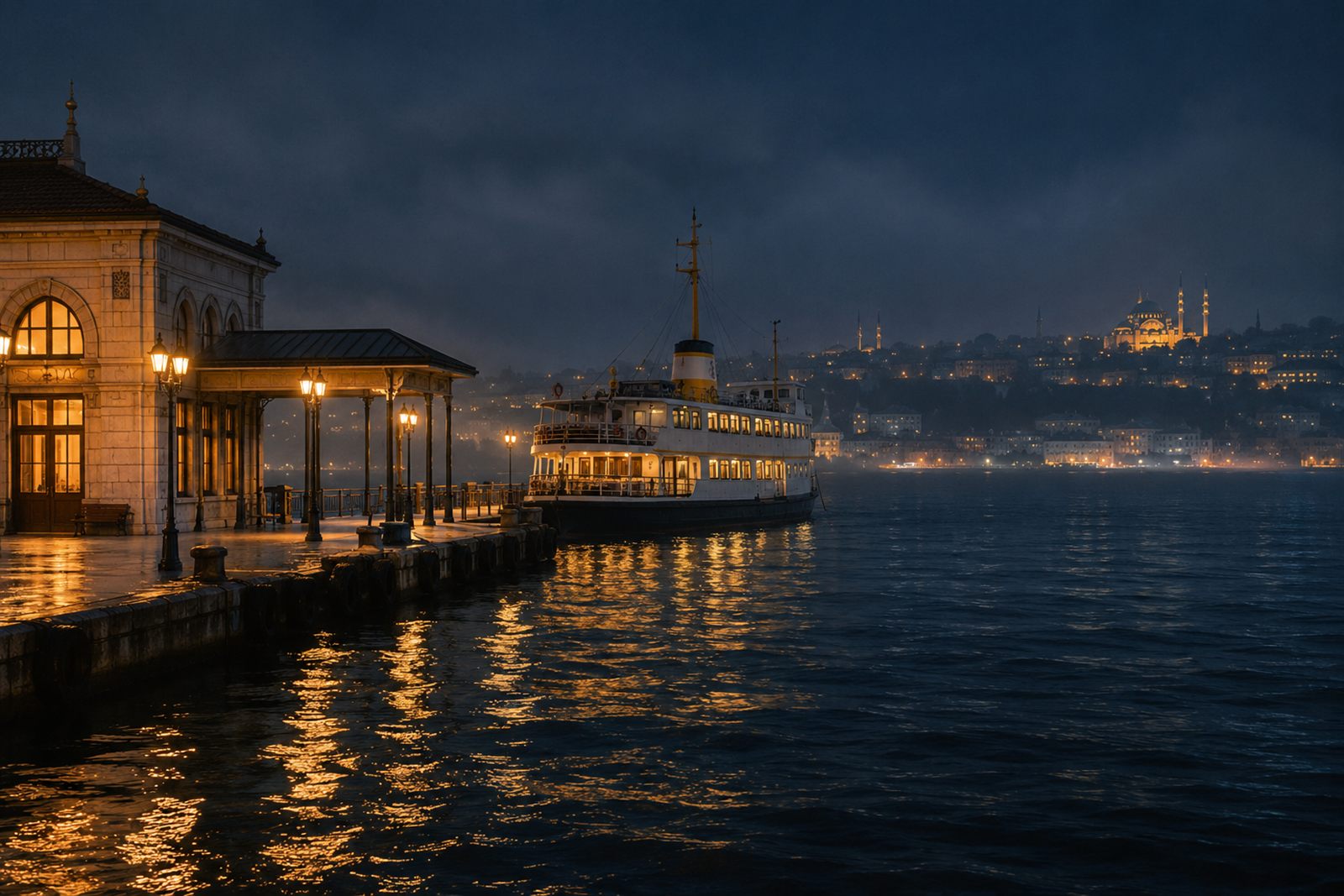
The ferry terminal has its own weather. Wind finds the gaps between coats, gulls hang above the lamps and the smell of tea travels farther than it should. Across the water, the city is reduced to a constellation whose streets can only be guessed.
A late crossing is not the fastest way home. That is part of its value. Passengers choose seats by the window, set down paper cups and watch the shore pull away without ceremony.
A moving room
Inside, the ferry is ordinary: worn tables, practical lighting, the rattle of glass. Outside, minarets and apartment blocks share a single dark horizon. The distance makes the monumental and the domestic briefly equal.
The middle of the strait feels less like being between continents than being held between two versions of the same evening. On one shore, shutters are coming down. On the other, restaurants are still filling.
The final approach
As the ferry slows, separate lights become windows again. A dock worker catches the rope. The doors open before the engine has entirely settled and the passengers disperse with the efficiency of people who have made this crossing hundreds of times.
Ten minutes later the ferry is already leaving. Its warm windows move back into the dark water, becoming part of the view it carried us through.